What I was told not to do as a physicist
Beauty in physics and science#
Paul Dirac is famous as a physicist for many things. First, he is one of the founders of modern quantum physics and provided many of the mathematical tools still in use today, including the hegemonic bracket notation. He was also renown for his quiet character and his very direct speaking which made him look like an alien even among the physicists of the time. However, Paul Dirac wrote a lot about the way he worked and the deep connection he saw between mathematics and physics. He was very keen on looking for beauty in the mathematical writing of his theories and equations as this was one of his guidelines toward scientific progress.1
Even physicists more concerned with the adequacy between theory and experiment could not escape the fact that scientific research, and especially physics, was guided by a research of coherence and mathematical beauty, from Ptolemaic astronomical theories to quantum theory of matter and relativity. In the case of Heisenberg, he was conceding that beauty was a source of clarity and illumination in the natural sciences.23
But one can also argue that beauty can also be found in the correspondence between a theory and the phenomena it tries to explain. While this is certainly true, there is some form of dissatisfaction when a theory is extremely powerful at predicting phenomena but feels too complicated and convoluted, or if some of its argument are ad-hoc, not supported by evidence or mathematically debatable. A simple example of that can be found in the computation of the Casimir forces in which diverging infinite series are used in the computation, but disappear since in the end only their difference matters. The agreement between experiments and the theory is excellent, but the mathematical demonstration can feel a bit whacky since it calls for mathematics with no clear physical basis.
One could find many other examples of such theories that approximate the behavior of matter in more or less elegant ways and which describe the physics of matter with more or less accuracy. This tension is present in every single field of science.
Fitting data#
A first step in natural sciences is collecting data on the phenomenon one want to study. Then finding a framework than can give insights from these data, either pattern or underlying laws. This is the part where theoretician goes “Yeah I know this and that behave following this mathematical law, and I have to take into account this other aspect that can be considered as a damping factor to be determined so overall, the data should follow equation X.”
Now three situations can happen:
- The data clearly do not follow equation X. In this case, rinse and repeat, we have to find another equation to explain the data.
- The data fits to some regard or in a certain range. In this case, we have to understand were the discrepancy comes from, either error in the measurements or some misunderstanding of what is going on.
- The data fits very well with the equation. This is the best case scenario where the underlying model is likely to be a good understanding of the underlying phenomenon. However, there is still a catch here, because, as mentioned above, we can have a good model without proper understanding of what is going on or no understanding at all. Worse, similar models with different incompatible hypothesis can explain some data with the same accuracy and, in this case, we have to find a way to discriminate them, or find another model with a better explanatory power.4
This is a crude description of some scientific methods but it is sufficient for the following point. Indeed, there is a way to always fit data points to a model with restricted dependence to some underlying variables: using polynomials.
If you have any data set, lets say of a variable $y$ against a variable $x$, it is always possible to find a polynomial $P(x)$ so that for all your $y_i$ data points you have $P(x_i) = y_i$. But in this case, what you are doing has a name, and this name is quite expressive. It is called overfitting. And as the name implies, overfitting is a bad practice. It is bad mainly because overfitting is sure to give you poor understanding of your underlying phenomena as there is always noise in data collection and forgotten aspect of given phenomenon in your theory. But, to connect with the introduction of this post, overfitting is bad because it is ugly as hell. Now, guess where overfitting seems to be a rule of thumb more than something to avoid.
Data sciences in the 20th century#
The increase of computational power in the recent years has allowed to develop new tools and algorithms in data science. By new, I mean old stuff that was too costly to run on previous computers and that people could start to seriously deploy in the turn of the century. Neural networks based machine learning and deep-learning are among these techniques and are now the foundation of any modern data science model, from Netflix customer profiling to OpenAi agents and LLM. Today there is something magical about modern models answering questions such has “How can I help a male squirrel with an egg stuck in his cloaca?” or demonstrating that a molecule with atoms separated by a distance larger than the known universe cannot be properly represented by the current quantum theory formalism.5
But people seem to forget how these models were built in the first place. And an image is sometimes worth 1000 words:
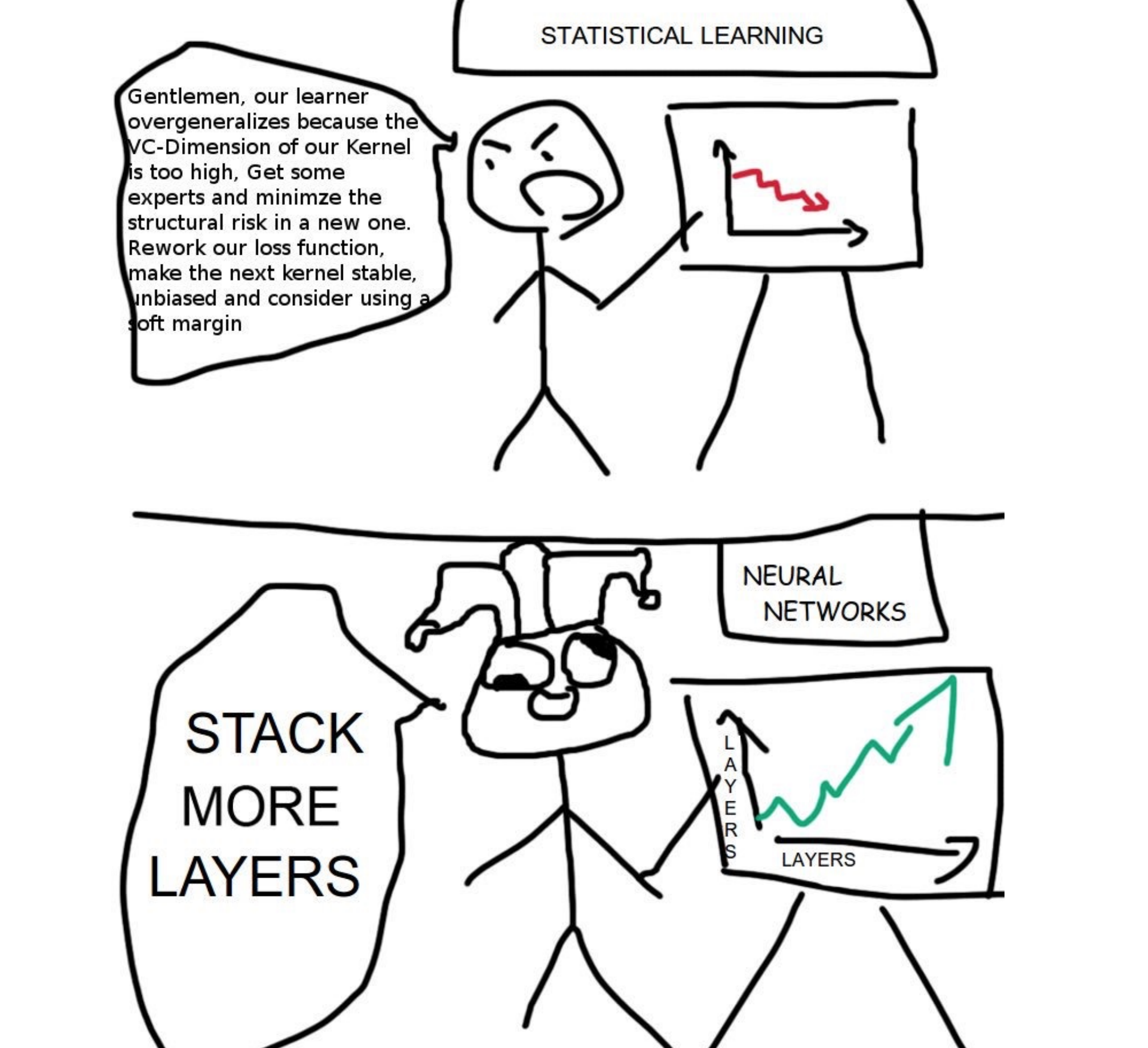 It was a joke in the 2010s that the data science community working on deep
learning was very keen to say that if a model performs poorly, it surely needs
more neural layers. This is not a joke anymore, this is any AI company
scientific plan: bigger models, more training data, more compute.
Now there is something to be asked about all of this: what are they trying to fit in the first place? When OpenAI LLM models where shit at playing chess, they tuned them to be able to play chess. When their mathematical skills were ludicrous, they tuned them to be able to solve math problems. So far now as to scare mathematicians on how good they are at pissing papers just the way the current scientific system loves in order to measure “productivity”. This is done at the cost of a lot of energy and resources, in the context of a non-existent business model with a non-existent return on investment. Sure the models “work” if you define work as “do what they were trained to do” or “produce a lot of slop that highly specialized people now have to decipher so we can make sense out of it”. Another meme stated that Black Mirror’s scenarios were written by a stoned british dude mumbling stuff like “wot if ya mum ran on battery?” and this is the feeling OpenAI (or Anthropic, same shit) models give me.6
Overall I cannot help but see this just as what I described above: a giant model overfitting over impressive questions but with questionable outputs. People claiming that this is a mathematical modeling of consciousness are laughable. People considering that this is the future of science, especially scientist are disappointing me. I think they don’t care and that’s good for them.
But overall in the end, this is exactly what I was trained not to do and the tools I was trained not to use as a scientist, and especially as a physicist. And as such, as a scientist, this is why, in addition to the detriment it causes to the environment and its social consequences, I see the use of such models and methods as a pathetic parody of science.7
-
See for example his article for Scientific American in which the word “beauty” and its derivatives appear something like 9 times to describe equations. ↩︎
-
See his lecture on the topic Heisenberg, Werner. “The Meaning of Beauty in the Exact Sciences.” (2012) ↩︎
-
Oh and I’m ready to believe that he was also a non-assuming cryptonazi. But that is another topic. ↩︎
-
An illustrating example could be the current problem of quantum gravity for which both the strings theory and the loop quantum gravity theory have been proposed. There are other candidate theories but as for now these are the two main approaches and no experiment has been set to discriminate between the candidate models. ↩︎
-
The first example is something ChatGPT gave me a serious response about even if male squirrels have no cloaca and lay no eggs. The other is the content of one of OpenAI 700 something mathematical papers which is bogus beyond anything I’ve read in physics. Flat earth theories makes more sense. ↩︎
-
A funny thing with these mathematical papers publication is that OpenAI only released 700 something of them that makes sense, but only to solve around 300 problems around 4000 that were asked. Maybe the slop concerning the 3600 other problems was just mumbling mathematical non-sense. ↩︎
-
You can disagree with me. I’m okay with that. ↩︎